I love to research and learn how brain can be engaged in the classroom learning . Learning happens when children are feeling safe and good about activities they do.The resources I create for my students focus on making learning fun while focusing on critical and higher order thinking skills. Doing my best to help them stay in an inspired and motivated mental states gives me an immense deal of satisfaction. It inspires me to see them inspired and happy. I love to see young minds staying engaged and curious in my classroom. I thought it would be nice to share what works in my classroom to engage kids in creative and meaningful learning process. Also, I would love to share some kind of freebie on my blog from the resources I create for my storefront on Teachers Pay Teachers while I share how do I use them in my classroom and what kind of response I get from the kids.
Showing posts with label Phonics. Show all posts

Interactive Flipbooks are Always FUN to Learn


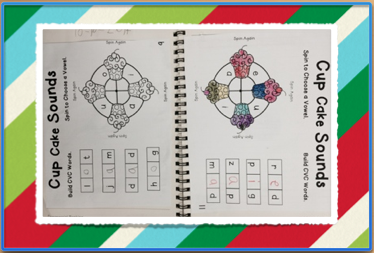
I was excitedly waiting to practice the interactive flip book I created for my students to reinforce CVC word work. I was thrilled to see how could this versatile resource be converted into interactive notebook templates as well.
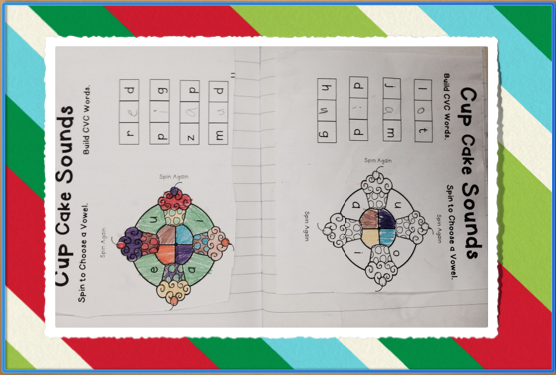
So, I had the choice either to let kids practice and bring home an independent flipbook or use the pages as interactive notebook templates. I chose to go for the second option and let the kids paste the templates on their interactive notebooks this week.


Interactive CVC Flipbook


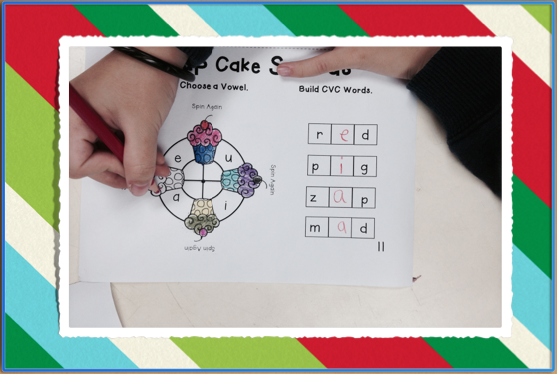
Kids enjoyed guessing the CVC words using Spinner and creating CVC words.

The interactive flipbook is FUN for kids as they have choice  of activities to practice CVC words while they get to decorate the cupcakes. The activities in this flipbook could be extended through the blank templates I have included for the extra practice.

One of the practice worksheets require them to identify and color the vowel sound inside the cupcake. Then, they mix the consonants found on the cupcake to create CVc words. Another practice worksheet offers a mix of consonant and vowel sounds to let them think and build words.


Interactive Flipbooks are Always FUN to Learn


I was excitedly waiting to practice the interactive flip book I created for my students to reinforce CVC word work. I was thrilled to see how could this versatile resource be converted into interactive notebook templates as well.
So, I had the choice either to let kids practice and bring home an independent flipbook or use the pages as interactive notebook templates. I chose to go for the second option and let the kids paste the templates on their interactive notebooks this week.


Interactive CVC Flipbook


Kids enjoyed guessing the CVC words using Spinner and creating CVC words.

The interactive flipbook is FUN for kids as they have choice  of activities to practice CVC words while they get to decorate the cupcakes. The activities in this flipbook could be extended through the blank templates I have included for the extra practice.

One of the practice worksheets require them to identify and color the vowel sound inside the cupcake. Then, they mix the consonants found on the cupcake to create CVc words. Another practice worksheet offers a mix of consonant and vowel sounds to let them think and build words.


Phonics Practice for Short Vowel Aa

Phonics practice for short vowel a is provided in Brain Domain Phonics Kit. Teaching how to decode 3 letter CVC words is critical to future success with much advanced phonics structures. This activity set explains step by step process of how to teach children to read words through blending in an explicit and systematic manner. The mp3 is included to hear the 6 letter sounds to be introduced in the classroom.

Click Here to Download this Activity

Directions:
Print, cut, and laminate the picture cards.

Activity set includes

a) Step-by-step Lesson Plan with detailed instructions
b) 1 mp3 audio file of 6 sounds for teacher's reference
c) 6 letter cards (1 vowel card and 5 Consonant Cards)
d) 2 Practice Worksheets

Please leave feedback if you download this activity, as I am always interested in what other educators/parents think of the materials I create for my own students and share with others.

Letter Sounds in Phonics

Letter Sounds in Phonics Can be Taught to Preschoolers as Early as 3 Years of Age or Even Earlier


Letter Sounds in Phonics helps children understand the relationship between the spoken and written words. Many parents believe that child will learn to read when he will enrol in the school. However, the truth is many children lag behind their literacy age after joining school. There are numerous factors behind it. Parents must educate themselves that language is not similar to maths or other subjects taught in school. Language learning is closely related to the functions of the brain that are in highly optimised state in early years after birth. Learning to read letter sounds and words is much easier when preschoolers are given opportunity to practice language in a playful and natural manner by parents and caregivers. You are your child's best teacher in the early years!

Alphabet Glass Craft for Reading & Phonics

Alphabet Glass Craft is Easy FUN to do with Kids


Alphabet Glass craft for reading and phonics can be used in many ways. It can be used to teach alphabet names and sounds as well as to teach more advanced stages of reading such as blending individual sounds to form words. This craft activity uses letter tiles to help the preschooler identify and differentiate the alphabet names and sounds. You can also use cards with uppercase and lowercase alphabets printed together on one card.


1 You will need blue tack, scissors, plastic glass or any disposable glass and a set of medium or small alphabet cut outs as shown below:


alphabets, phonics, reading, crafts


2. Put all 26 alphabet cutouts in the plastic glass and cover its mouth with your hand to give it a good shake. Let your child pick up one card and say aloud the name of the letter and let the child repeat the name. Then say aloud the sound of the letter and let the child repeat it.. Help the child put the blue tack at the back of the cutout and stick it on the glass.

alphabets, phonics, crafts, reading

3. Take turns with your child. Ask the child to shake and let you pick up the card. You can say aloud the name and sound and the child repeats. You can stick on the cut out on the glass. Children love this as they end up creating an alphabet glass you can put somewhere they can look and point. You can use this glass for review throughout the day going in and out of your kitchen or living area.

phonics games, reading games, kids crafts, alphabets


4. Teaching your child is as easy as breeze if you pay attention to various skills and strategies available.

Return Home

Brain Domain Phonics

Phonics


Phonics is FUN n Easy


Phonics taught at Brain Domain uses effective and  methods to ensure guaranteed results.


What is Brain Domain Phonics?


Brain Domain Phonics is a method of teaching how spoken words are composed of sounds called phonemes, and how the letters of words correspond to those phonemes. The process of reading involves 'decoding' words into their sounds, so that meaning can be extracted from the speech made up of these sounds. We use synthetic phonics in combination with brain based teaching and learning methods to accelerate the learning process.


What is meant by the term 'synthetic' in Brain Domain Phonics'?


This has nothing to do with being artificial, or being made of plastic! It is to do with putting things together. You synthesize when you blend together the component sounds of a word to produce the sound of the word as a whole. Thus putting the sounds /k/, /a/ and /t/ together produces the sound of the word 'cat'. It is a Eureka moment for a child, when they find they can do this by themselves for


 a new word - to find out what it means by how it sounds. It opens the whole world of books to them.


What is the "whole language" approach to phonics?


The alternative approach (called the 'whole language', 'whole word' or 'look and say' approach) is to teach the recognition of whole words and associating the pattern of letters and shape of word directly with the meaning of the word. The theory is that, to read rapidly, one needs to have immediate recognition of whole words, and direct access to their meaning. Words that cannot be so recognized may be understood from context, grammar, etc.


Why is Brain Domain phonics better?


Brain Domain Phonics is better because it teaches how to decode all words, including unfamiliar words. Typical reading matter is composed of a mixture of "content words" conveying the essential meaning, and"function words" which provide a framework or glue. The content words tend to be relatively uncommon words, and phonics gives the reader a method of decoding such words.


What is phonemic awareness?


Phonemic awareness is awareness of how words are composed of phonemes. It is an essential element of phonics teaching from the beginning. It is often included in the whole language approach,but not as a starting point.


What is the evidence in support of synthetic phonics?


Studies have shown that after teaching children synthetic phonics "first and fast" when they enter Primary School, the children's reading progresses above average, and by the time they leave school at eleven, their reading age is over three years ahead of their chronological age, i.e. they are three years ahead of their peers. 100% of pupils had achieved a satisfactory reading level by age 11, as compared to around 80% for the national average.


Can Brain Domain Phonics be used at any age, and for reading recovery?


Yes. All the evidence suggests that basically the same phonics method can be used for the initial teaching of reading at any age, and for reading recovery at any age.


Can Brain Domain Phonics overcome dyslexia?


There is no doubt that there is a biological basis to dyslexia, and some culprit genes have been identified. However, with synthetic phonics, it is normally possible to teach even the most dyslexic child to read. Indeed, the symptoms of dyslexia are often aggravated by other teaching methods, particularly the 'whole language' approach.In particular, the teaching of a large number of sight words actually hinders the development of the pathways in the brain that allow rapid decoding.